


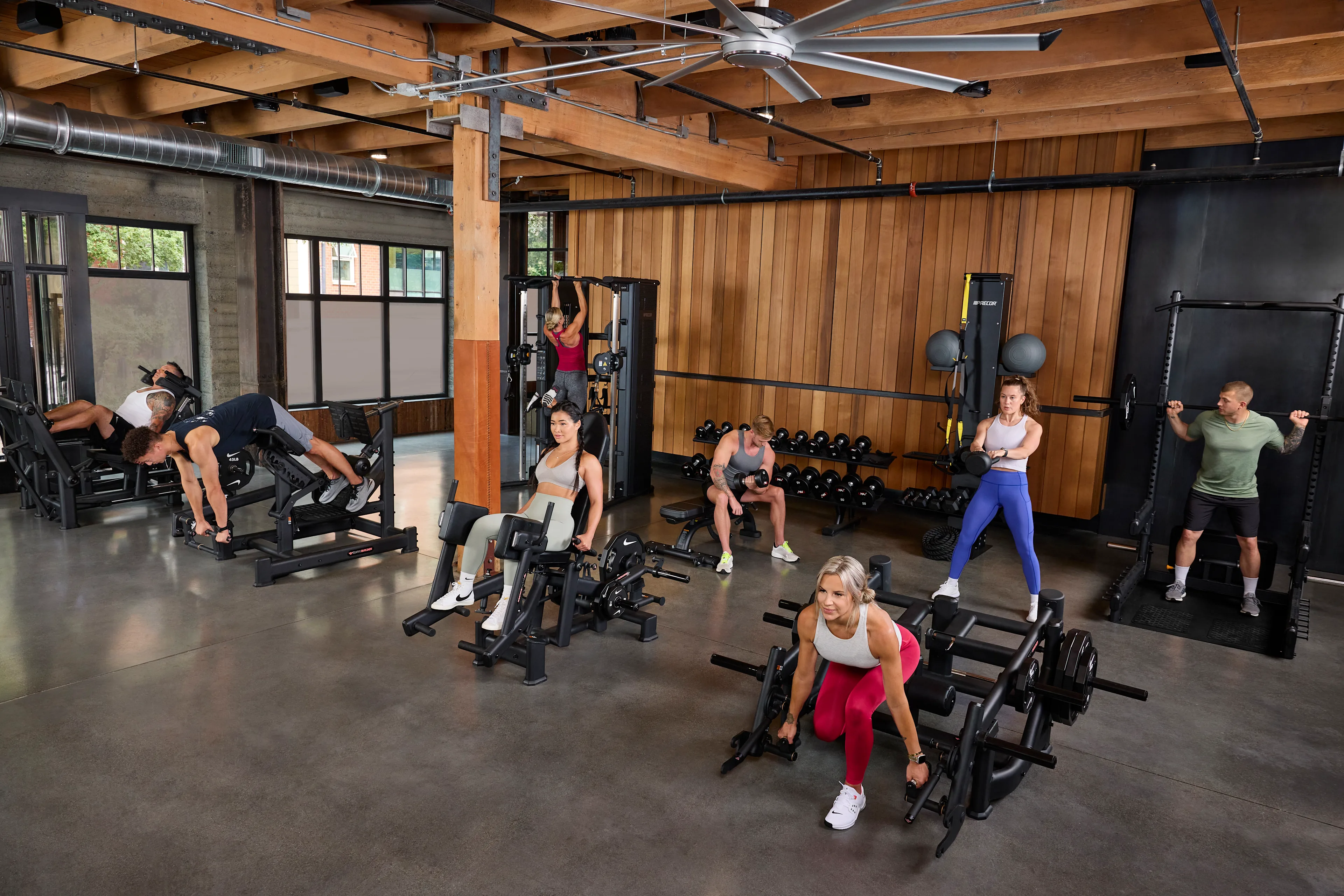

The modern fitness floor is undergoing a quiet — but profound — transformation.
Not because of new equipment alone, but because of a fundamental shift in how people train, think and engage with movement.
Today’s exerciser is not simply “doing cardio” or “lifting weights”. They are navigating a dynamic experience shaped by goals, time constraints, digital influence, recovery needs and a desire for autonomy. Yet many facilities are still designed around legacy categories — rows of cardio machines, fixed strength circuits and isolated zones that no longer reflect how people actually move.
For operators, this creates a gap: When the environment doesn’t match behaviour, engagement drops.
The opportunity is clear — rethink the fitness floor through the lens of modern behaviour, not outdated structure.
The shift: How members actually train today
Across the industry, several behavioural trends are consistently emerging:
1. Blended training is the new norm
Members are no longer siloing their workouts.
A single session may include:
Short bouts of cardio
Strength training
Mobility work
Recovery elements
According to the International Health, Racquet & Sportsclub Association (IHRSA), members increasingly seek multi-modality training experiences within one visit, prioritising efficiency and variety.
Similarly, the American College of Sports Medicine (ACSM) highlights functional training, strength and recovery integration as top global trends.
Implication:
Rigid zones (cardio → strength → stretch) don’t match how people naturally flow through sessions anymore.
2. Shorter, more intentional workouts
Time is a constraint — and members are adapting.
High-value, efficient sessions (20–45 minutes) are replacing long, linear workouts. This includes:
Interval-based cardio
Superset strength training
Circuit-style formats
The Les Mills Global Fitness Report found that high-efficiency training formats continue to drive participation, especially among younger demographics.
Implication:
Members don’t want to “walk the floor”.
They want clarity and immediacy — what to do, where to go and how to start.
3. Guided experiences are driving confidence
Despite the rise of independent training, members still seek guidance.
Not necessarily from a trainer — but from:
Digital coaching
On-demand workouts
Visual cues and prompts
Structured programming
According to McKinsey & Company, 70% of consumers prioritise fitness experiences that provide guidance and personalisation, even in self-directed environments.
Implication:
Spaces that “teach” members how to use them outperform those that leave interpretation up to the user.
4. Recovery is now part of the workout
Recovery is no longer an afterthought — it’s part of the training experience.
Members are actively integrating:
Mobility work
Breathwork
Recovery modalities
According to the Global Wellness Institute (2025), the global wellness economy reached a record $6.8 trillion in 2024, reflecting the accelerating consumer demand for health, fitness, recovery, longevity and wellbeing experiences worldwide.
Implication:
Facilities that separate recovery from the main floor miss an opportunity to enhance engagement and perceived value.
Why legacy layouts are falling short
Traditional layouts were built for a different era — one where:
Workouts were longer and more linear
Equipment categories defined behaviour
Guidance came primarily from trainers
Today, those same layouts can create:
Decision fatigue (Where do I start?)
Low confidence (Am I doing this right?)
Disjointed flow (Why am I walking across the gym constantly?)
The result is subtle but significant:
Members disengage — not because they don’t want to train, but because the environment doesn’t support how they train.
Designing for behaviour: The role of confidence, clarity and cues
Modern fitness floor design is less about equipment placement — and more about behavioural architecture.
Three principles are driving more effective spaces:
1. Confidence
Members should feel capable the moment they step onto the floor.
This comes from:
Intuitive layouts
Clear zones of purpose
Equipment that invites use
2. Clarity
The environment should answer the question:
What should I do here?
This can be achieved through:
Defined training areas (not just equipment groupings)
Visible programming suggestions
Logical flow between zones
3. Behavioural cues
The most effective spaces guide action without requiring instruction.
Examples include:
Visual pathways between modalities
Equipment arranged for circuits or sequences
Integrated digital guidance
Evolving the fitness floor — without rebuilding everything
A common misconception is that meaningful change requires a full redesign.
In reality, operators can create an immediate impact by rethinking how existing spaces are used.
Practical shifts that drive results
1. Create training “Experiences”, not just zones
Reorganise equipment into purpose-driven areas:
Strength and conditioning circuits
Functional movement zones
Guided cardio experiences
2. Integrate cardio into the flow
Rather than isolating cardio, position it as part of:
Warm-ups
Intervals within strength sessions
Recovery transitions
3. Layer in guidance
Add:
Digital coaching interfaces
On-demand workouts
Simple visual prompts
4. Bring recovery onto the floor
Incorporate:
Mobility spaces
Regeneration tools
Low-barrier recovery options
5. Design for movement, not machines
Think in terms of:
Patterns (push, pull, hinge, rotate)
Energy systems (aerobic, anaerobic)
User journeys
Where Precor fits in: Building a smarter ecosystem
The shift in behaviour aligns directly with Precor’s Build your movement philosophy.
Rather than viewing cardio, strength and wellness as separate categories, the modern facility benefits from a connected ecosystem that supports:
Seamless transitions between modalities
Integrated, guided experiences
Equipment designed around real user behaviour
Precor’s approach enables operators to:
Build intuitive pathways across the floor
Support both independent and guided training
Create environments that feel relevant, modern and engaging
This isn’t about adding more — it’s about aligning what’s already there with how people actually move.
The future fitness floor
The most successful facilities won’t be defined by the amount of equipment they offer — but by how well their spaces support human behaviour.
Because ultimately, members don’t engage with equipment categories.
They engage with experiences that feel:
Clear
Confident
Connected
Purposeful
Design for that — and the modern fitness floor becomes more than a place to work out.
It becomes a place people want to return to.
References
American College of Sports Medicine. (2024). ACSM’s worldwide survey of fitness trends.
Global Wellness Institute. (2025). 2025 Global Wellness Economy Monitor. https://globalwellnessinstitute.org/industry-research/2025-global-wellness-economy-monitor/
International Health, Racquet & Sportsclub Association (IHRSA). (2023). Health Club Consumer Report. https://www.ihrsa.org
Les Mills. (2023). Global Fitness Report. https://www.lesmills.com
McKinsey & Company. (2022). The future of wellness: Trends shaping consumer behavior. https://www.mckinsey.com